
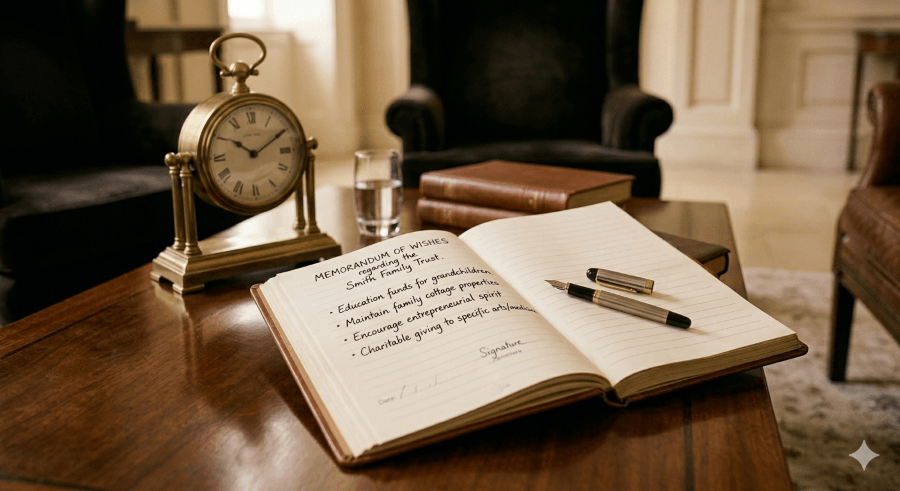
If the Trust Deed is the skeleton of the trust legal structure, the Letter of Wishes (LoW) is its heart, providing the intent and philosophy behind the Settlor’s decisions, acting as a personal guide for the Trustee.
While the Trust Deed uses formal language to set the “rules of the trust,” a Letter of Wishes is an informal and confidential document where the Settlor speaks directly to the Trustees in plain English, allowing to explain exactly how the trust’s assets are to be used in various life scenarios -such as funding a specific type of education for children or managing a family business- without making those instructions part of a rigid, permanent legal contract, i.e. Trust Deed.
One of its greatest strengths of the LoW is that it is legally non-binding, which paradoxically provides more flexibility and control. Because it isn’t a legal part of the trust deed, it can be updated, rewritten – on a napkin, if necessary- or destroyed at any time by the Settlor without needing a lawyer to draft a formal amendment of the Trust Deed.
While Trustees aren’t legally forced to follow the LoW, they have a fiduciary duty to take the Settlor’s intent into serious consideration when making decisions. In practice, most professional Trustees follow these letters closely, often to the letter -because they provide the context needed to exercise the Trustee’s “discretion” properly-, unless doing so would be illegal or jeopardize the trust’s safety.
Furthermore, a LoW remains strictly private. This makes it the ideal place to address sensitive family dynamics or explain the “why” behind certain decisions -e.g. why one beneficiary is receiving more than another- without airing that information in a public court as in case of a will during the probate process. Moreover, since the world changes, the LoW enables the Settlor to give guidance on future scenarios not predicted today, such as how to handle a beneficiary who develops a substance abuse problem or how to manage a family business, if the market conditions shift.
Do you want to know more about Trusts, where and how to start setting up your own trust? Reach out to us at +44 20 3974 1244 or at office@bensonformations.com. We are ready to navigate you through this complex field to the right solution for you.